The first cabin I bought had a single light in every room. Bare bulb in the kitchen, ceiling fixture in the living room, bathroom vanity bar that hummed. I thought I'd replace them with nicer versions of the same thing. Four cabins later I understand that I had the whole approach wrong.
Log cabin lighting isn't about replacing fixtures. It's about understanding what dark wood does to light and working with that instead of against it.
Dark log walls absorb light. A room that would be bright and airy with white drywall walls becomes cave-like with stained pine or chestnut logs. Not necessarily bad, a cave can be the exact thing you want in a mountain cabin, but you have to light it differently. A single central fixture in a log room gives you one bright spot and dark corners. That's the worst lighting scenario in any interior, and it's especially wrong in a cabin where the whole point is warm envelopment.
The Rule That Changed Everything: Light from Below the Eye Line
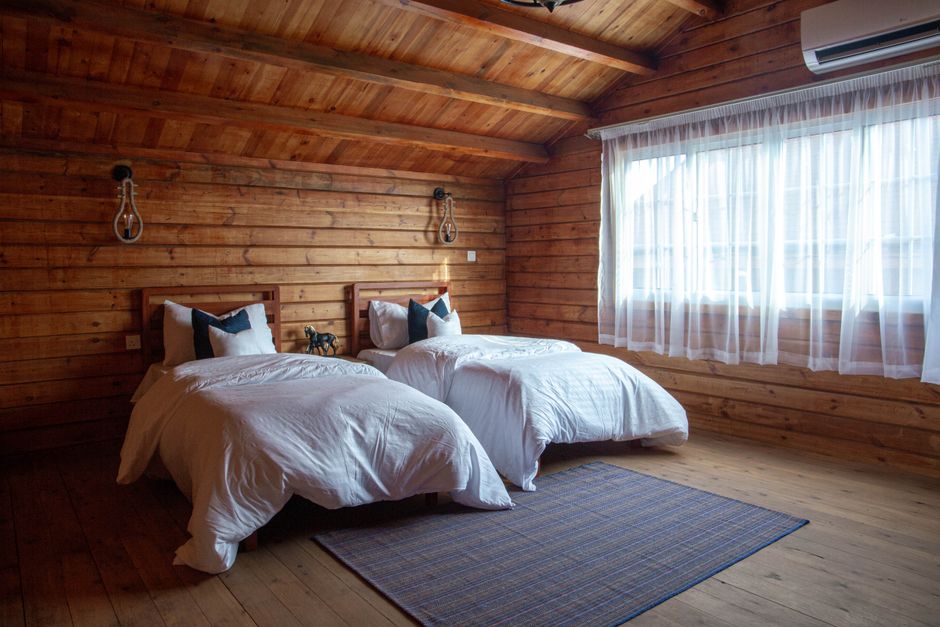
On cabin two, I started experimenting with lower light sources. Table lamps on the bedside tables. A floor lamp in the living room corner. Plug-in sconces on the bedroom walls at 58 inches instead of overhead fixtures. The rooms immediately felt warmer, more deliberate, more like what you picture when you imagine a mountain cabin at night.
The physics: light from above casts shadows downward, which reads as bright but institutional. Light from below eye level casts shadows upward, which reads as warm and intimate. In a dark wood room, the shadows are already there. What you're adding is warmth at eye level, and that's what makes a room feel like a refuge rather than a shed with furniture in it.
Every cabin I've done since cabin two has at least four lower-level light sources in the living area: two table or floor lamps and two wall sconces. The overhead fixture stays, on a dimmer, for cleaning and cooking. For actual living, for the evenings people rent these cabins for, the overhead stays off or goes very low.
The One Fixture I Put in Every Single Cabin
Plug-in wall sconces flanking the bed. Every time. No exception.
In a rental cabin, guests don't want to fumble for a table lamp switch in the dark. They don't want a lamp that takes up half a small nightstand. And they absolutely don't want overhead light in the bedroom at 10 p.m. after hiking all day. A sconce mounted at 58 inches from the floor, on each side of the bed, on a switched outlet, solves every one of these problems.
The ones I use now are from BO-HA, a simple iron arm with a fabric shade in oat linen. They photograph well against log walls, they take a standard E26 bulb so I can swap to 2700K warm white, and plug-in means I can move them if I reconfigure a room without calling an electrician. On cabin four I moved the bedroom sconces three times before landing on the right position. Can't do that with hardwired.
Bulb Temperature in a Dark Wood Interior
2700K. That's it. No higher.
I tried 3000K in cabin three, which is common in kitchen fixtures and looked fine in the photos. In person, against the honey-coloured pine logs, it read as slightly greenish. Not terrible. But not right. 2700K reads as amber and firelit in a wood room, which is exactly the register you want. The wood seems to warm up around it.
3000K for task areas where I have to be accurate, under-cabinet kitchen lights, and 2700K everywhere else. That's the cabin lighting rule.
Where I Got It Wrong: The Kitchen
The kitchen in cabin one had fluorescent tube lights under the upper cabinets and a ceiling fan with a light kit in the middle. I replaced the ceiling fan with a simple drum pendant, kept the undercabinet lights, and called it done. It was not done.
The undercabinet lights were 4000K cool white, which I didn't notice until a guest review mentioned the kitchen felt "clinical." They were right. It was the one room in the cabin that felt like it belonged in an office building. I've since replaced undercabinet strips with 2700K tape lighting in all four cabins and the complaint has never come back.
The kitchen pendant matters too. I use a simple pendant with a visible warm bulb over the island now, nothing dramatic, just a 12-inch dome in matte black that doesn't compete with the wood. It reads well in photos and throws enough light over the prep area without washing out the room.
The Short Version
Log cabin lighting: 2700K everywhere. Lower light sources, not just overhead. At least four light sources in any living area. Sconces at 58 inches on each side of the bed. Put the overhead on a dimmer and leave it at 20% after 7 p.m.
Four cabins, about $800 in lighting fixtures per cabin, and the difference between a room guests call "cozy" and a room they call "nice." The word cozy is the one that gets you booked again.