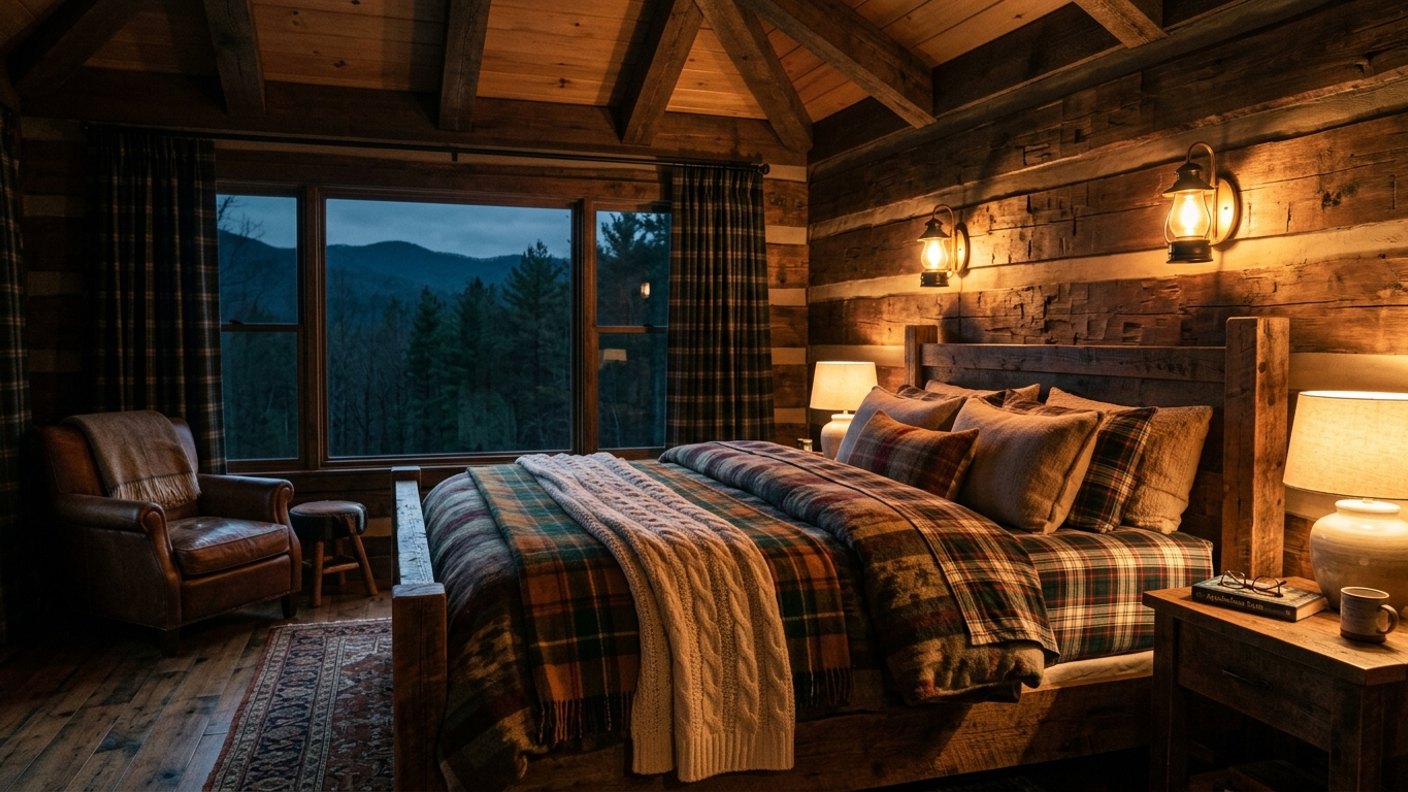
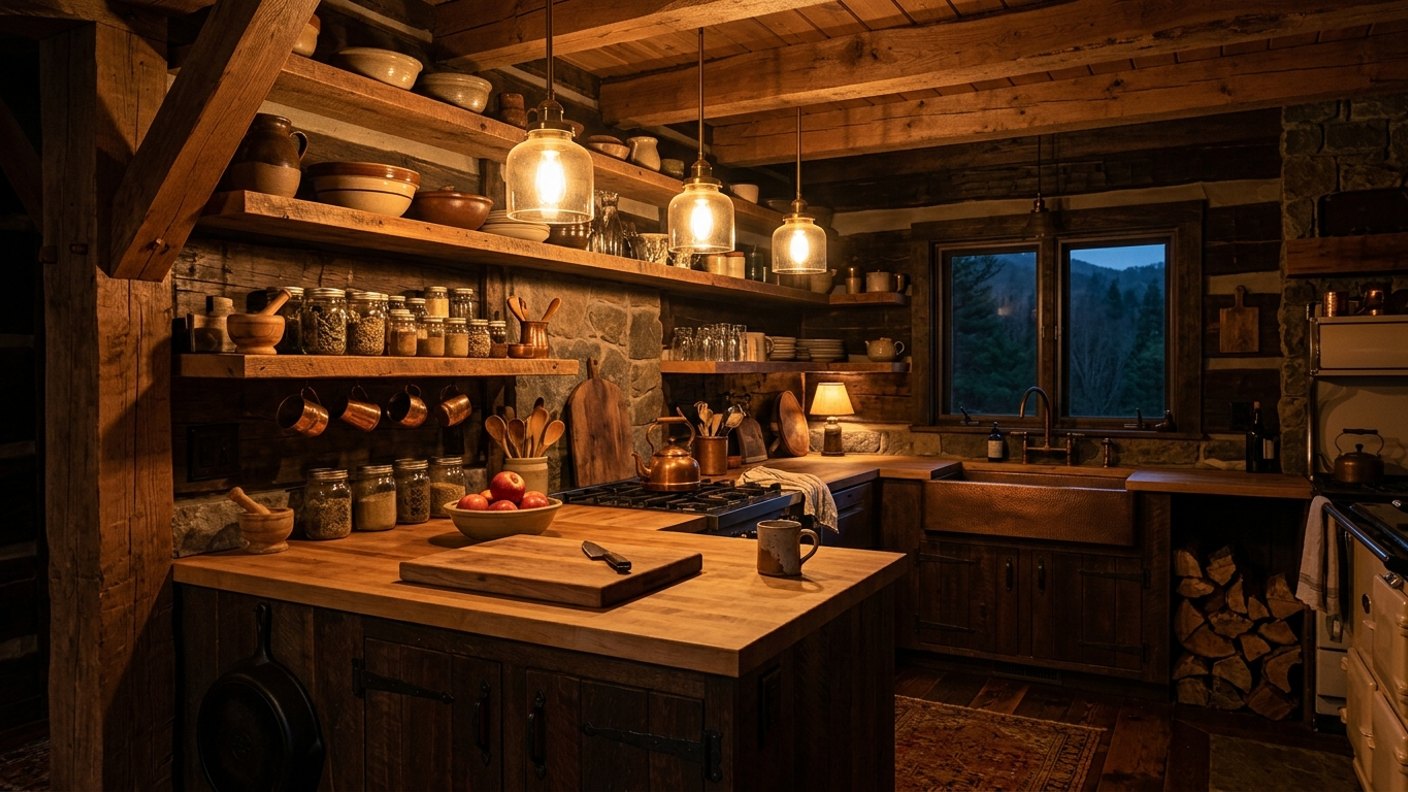
Screened porch lighting for a cabin comes down to five low, warm sources instead of one overhead: a cage pendant on a dimmer at 35 percent, two plug-in swag pendants in opposite corners, a string of Edison bulbs along the screen frame, and a rechargeable lantern on the side table, all at 2200K and all damp-rated, because a porch wants to feel like outside and light like inside. The screened porch on my Blue Ridge cabin is 14 by 10 feet, faces east over the tree line, and sits about 3 feet off the ground on a stone foundation; I spend more time on it than anywhere else on the property from May through October, and getting the lighting right took two full seasons of iteration. This is the whole of it: the single overhead that looked like a garage, the five-source system and what each does, the dew and the damp ratings, the swag hooks in the joists, the string along the screen and the glow it makes, the lantern and its charge, the bulbs and why 2200K, the dimmer, the outlet problem, the porch at three times of night, the bugs, the winter shutdown, the cost, the mistakes, and the rule the porch taught me.
The Starting Point: One Overhead Fixture
When I bought the cabin the porch had one ceiling box centered in the ceiling with a bare bulb socket and a pull chain. Single-source overhead light on a porch does not work: it creates a flat, even brightness that eliminates the atmospheric shadows that make a porch feel like a porch, and it lit the screens so they reflected the room back at you and hid the trees. It looked like a garage, and for the first summer I sat out there with it off and a headlamp, which is not a lighting plan.
Source One: The Cage Pendant
I kept the ceiling box but changed the fixture to a vintage-style cage pendant, black, with a 40-watt-equivalent amber LED at 2200K, on a dimmer switch inside the door, and it runs at about 35 percent. It provides general orientation light without flooding the space: enough to find the chair and the beer, not enough to flatten the room. The cage throws a faint pattern on the ceiling boards, which is the only decoration the ceiling has. It's the source I'd have alone if I could only have one, and it's the one I'd never have alone by choice.
Sources Two and Three: The Swag Pendants
Two plug-in swag pendants on opposite corners of the porch, hung from swag hooks screwed into the ceiling joists, black metal fixtures with exposed amber globes, plugged into outdoor-rated extension cords run to the single porch outlet along the top of the screen frame. They create pools of warm light in the corners that draw the eye and make the space feel larger, because a lit corner is a corner the eye travels to; the far corner over the reading chair is the one that gets used, and the near one is the one that makes the porch look right from the yard. Swag pendants are the porch fixture that needs no electrician and a joist.
Source Four: The String Along the Screen
A string of S14 LED Edison bulbs along the interior of the screen frame on the long east-facing wall, clipped to the frame every 2 feet, 2200K, on their own plug-in dimmer. The screens themselves glow very slightly at the bulb positions, creating a soft illuminated wall effect when the porch is in use, and from the yard the porch looks like a lantern in the trees; this is the most atmospheric element of the setup and the one guests photograph. Along one wall only, because a string on all four is a beer garden.
Source Five: The Rechargeable Lantern
A rechargeable lantern on the small side table that serves as my reading and coffee surface, 2200K, dimmable, that runs 8 to 10 hours on a charge; I charge it inside and bring it out, and it needs no wiring, which on a porch with one outlet is the point. It's the reading light and the light that goes to the steps when someone leaves, and it's the one source that comes inside in November.
The Humidity Issue
The east-facing exposure at altitude means heavy morning dew from April through June, and everything on this porch gets wet on foggy mornings. I replaced one set of non-rated fixtures after the first summer when a socket corroded and a pendant went dead. Now the swag pendants are damp-rated, the string lights are outdoor-rated, the cage pendant is damp-rated with a sealed socket, and the rechargeable lantern has a rubber-sealed charge port; nothing has corroded since the second season. A screened porch is outdoors as far as a socket is concerned, and the rating on the box is the first thing to read.
The Swag Hooks
Two screw-in hooks into the ceiling joists, found with a stud finder through the beadboard, rated for 20 pounds each for a 3-pound pendant, with the cord swagged along the ceiling to the wall and down the screen frame's corner post in clips. The hooks are the only holes in the porch ceiling, and they're where the joists are and not where the corners are, which is why the pendants hang 14 inches in from the corners rather than in them. It looks intentional, and it's a joist.
The Bulbs, and Why 2200K
Every bulb on the porch is 2200K, amber, the colour of a candle or a fire, because a porch at dusk is competing with the sky going orange behind the trees and a 2700K bulb looks white against that; the porch's light should look like it belongs to the same evening as the sunset. Inside the cabin it's 2700K, the only bulb I buy; on the porch, one step warmer. Low lumens, 40-watt equivalents everywhere, because the goal is to see faces and not the floorboards.
The Dimmer
A wall dimmer inside the door for the cage pendant, and plug-in dimmers on the string and the swag pendants' cords, so every source can be low; the porch at dusk is the cage at 35, the pendants at 50, the string at 40 and the lantern on, and at eleven it's the string at 20 and the lantern. Without dimmers the five sources would be five points of glare, and with them the porch is a room with a light for every hour. The layering post is the same idea inside.
The Outlet Problem
One outlet on the porch, by the door, and five things that plug in: a six-way outdoor-rated power strip mounted under the side table, with the string, both pendants and the lantern's charger on it, and the strip on a smart plug that brings everything on at dusk and off at midnight. Running a second outlet would have been a permit and an electrician; the strip and the smart plug were $40, and the porch lights itself.
The Porch at Three Times of Night
Dusk, 8 p.m. in June: everything at its evening level, the trees still visible through the screen, the string just starting to show. Ten: the pendants down to 30, the cage off, the string at 30, the lantern at the chair, and the porch dark enough that the fireflies show past the screen. Midnight: the smart plug takes everything off except the lantern, which goes inside with me. Three settings, no switches touched after dusk, and the fireflies are the point of the second one.
The Bugs
A screened porch keeps the bugs off the people and not off the lights, and moths gather at the screen where the string is brightest; 2200K attracts fewer than a whiter bulb, and the string's dimmer at 30 after ten helps. The cage pendant's open cage collects a moth or two, and it's brushed out weekly. Amber bulbs, low lumens and a dimmer are the bug strategy, and it works well enough that the screen is for the mosquitoes and not the moths.
The Winter Shutdown
November: the lantern inside, the string unclipped and coiled in a bin, the swag pendants left up but unplugged with their cords coiled on the hooks, the cage pendant left on its dimmer for the two nights a winter it's warm enough to sit out. April: the reverse, in an hour, when the dew starts. The winterizing post is the rest of the cabin; the porch's shutdown is the last item on it.
What It Cost
The cage pendant, $65, and its dimmer, $22. Two swag pendants, $140, and hooks and cord clips, $15. The string, 24 feet, $45, and its plug-in dimmer, $14. The lantern, $50. The outdoor power strip and smart plug, $40. Extension cords, outdoor-rated, $30. About $420 for a porch that's the most-used room on the property for six months a year, and the $65 cage pendant replaced the bare bulb that made it a garage.
The Rustic-Industrial Question
Black metal, cage, exposed amber globes and Edison shapes: the porch's fixtures are rustic-industrial because the cabin is a 1970s A-frame with a stone foundation and exposed rafters, and a farmhouse lantern or a coastal rope pendant would have argued with it. BO-HA's outdoor range carries damp-rated fixtures that suit this kind of covered porch, and their rustic-industrial line fits the cabin aesthetic without looking like it was sourced from a big-box store, which is the line I'd send anyone with a porch and a stud finder to first.
The Porch as a Rental Feature
When this cabin was rented for a season, per the first-season post, the porch was the photo that booked it: the string glowing through the screen at dusk, from the yard, with the trees black behind. Guests wrote about the porch more than the cabin, and the smart plug meant it lit itself for them without a switch to find; the five sources cost $420 and were mentioned in more reviews than the wood stove. A porch lit like a room is a room, and a rental with an extra room books.
Sitting Out There
Coffee at six with the string off and the sun coming through the east screen; a book at eight under the lantern; a beer at ten with the string at 30 and the fireflies past the mesh, and the sound of the creek that you can't hear inside. The porch is where the property makes sense, and for the first summer it was a garage with a headlamp. Five lights, two seasons, and it's the room I'd keep if I could keep one.
If a porch has one outlet and a joist, it can have all five of these, and it can have them by Saturday for the price of a decent dinner in town.
A Porch Without a Ceiling Box
Skip the cage pendant and add a third swag pendant over the table, on a joist; the swag hooks and the extension cords do everything the box did, and a porch with no wiring at all can run the whole system from one outlet through the door. The rental cabin's porch has no box and has this setup, and nobody's noticed the difference except me.
Mistakes
A summer under a bare bulb with a headlamp. Non-rated fixtures the first season, and a corroded socket. The string on two walls for a month, which was a beer garden. Swag pendants hung in the corners on drywall anchors before the joists, and one on the floor. And 2700K on the porch the first year, which looked white against the sunset and which is the mistake that taught me the one-step-warmer rule.
What This Porch Taught Me
A screened porch is a transitional space; it wants to feel like outside but light like inside. The right lighting leans warm, comes from multiple low sources, and avoids overhead-only brightness; the goal is firefly, not floodlight, and five small warm lights at five heights are how you get there. Two seasons to learn it, $420 to build it, and six months a year of the best room I own.
Shop the porch: swag pendants for the corners and outdoor wall lights rated for a porch that gets wet