Log cabin maintenance comes down to four jobs on a calendar: wash the logs every spring, check and patch the chinking every fall, re-stain the sun-facing walls every three to five years and the shaded ones every five to eight, and walk the whole exterior with a screwdriver twice a year looking for soft wood. Do those four and a log cabin lasts a century. Skip them for a decade, which is what the previous owner of my third cabin did, and you're replacing bottom logs at $2,800 apiece. I've run this routine on seven cabins in the Blue Ridge, four of which I still own, and this is the actual checklist, by season, with what it costs and what I've gotten wrong.
If you own a log home and have never done any of this, don't panic and don't hire the first person who quotes you a full restoration. Start with the screwdriver walk in the next section. Most cabins that look rough are fine underneath. Some that look fine aren't.
The screwdriver walk: how to find out what you've got
Take a flat-head screwdriver and walk the outside of the cabin at the bottom two courses of logs, the corners, under every window, and anywhere a downspout dumps or a deck meets the wall. Push the screwdriver into the wood at an angle every couple of feet. Sound wood stops it. Rot lets it in a quarter inch or more with no effort. Mark every soft spot with a chalk circle and photograph it.
That's the whole inspection, and it takes forty minutes on a normal cabin. I do it in April after the snow's gone and in October before it comes back. On cabin three, the first walk found eleven soft spots, nine of them on the north wall under a roof that had been dripping onto the logs for years. On the cabin I live in, this spring's walk found zero. Both cabins are the same age. The difference is water.
Everything in log maintenance is about keeping water off the wood and letting the wood dry when water gets on it anyway. Gutters, roof overhang, grade sloping away, no plants touching the logs, no firewood stacked against the wall. Get those right and the rest of this list is easy. Get them wrong and the rest of the list is a losing fight.
Spring: wash the logs
Every April, once it's reliably above 50 degrees. A garden sprayer with a log wash, which is usually an oxygenated bleach product made for wood, sprayed on, left ten minutes, scrubbed with a soft brush on a pole where there's mildew, then rinsed with a hose from the top down. Not a pressure washer. I know everybody has one. A pressure washer drives water into the checks in the logs and blasts the soft grain out of old wood, and I've seen a cabin's whole south wall turned fuzzy by a weekend warrior with a rented machine. Hose pressure and a brush.
Cost: about $60 in wash for a 1,200-square-foot cabin, and a full day. This is the job that makes a cabin look cared for, and it's also when you find out where the mildew is, which tells you where the water is, which tells you where the rot will be in five years.
Let it dry three days before you do anything else to it. Wet logs don't take stain and don't take chinking.
Fall: chinking and caulk
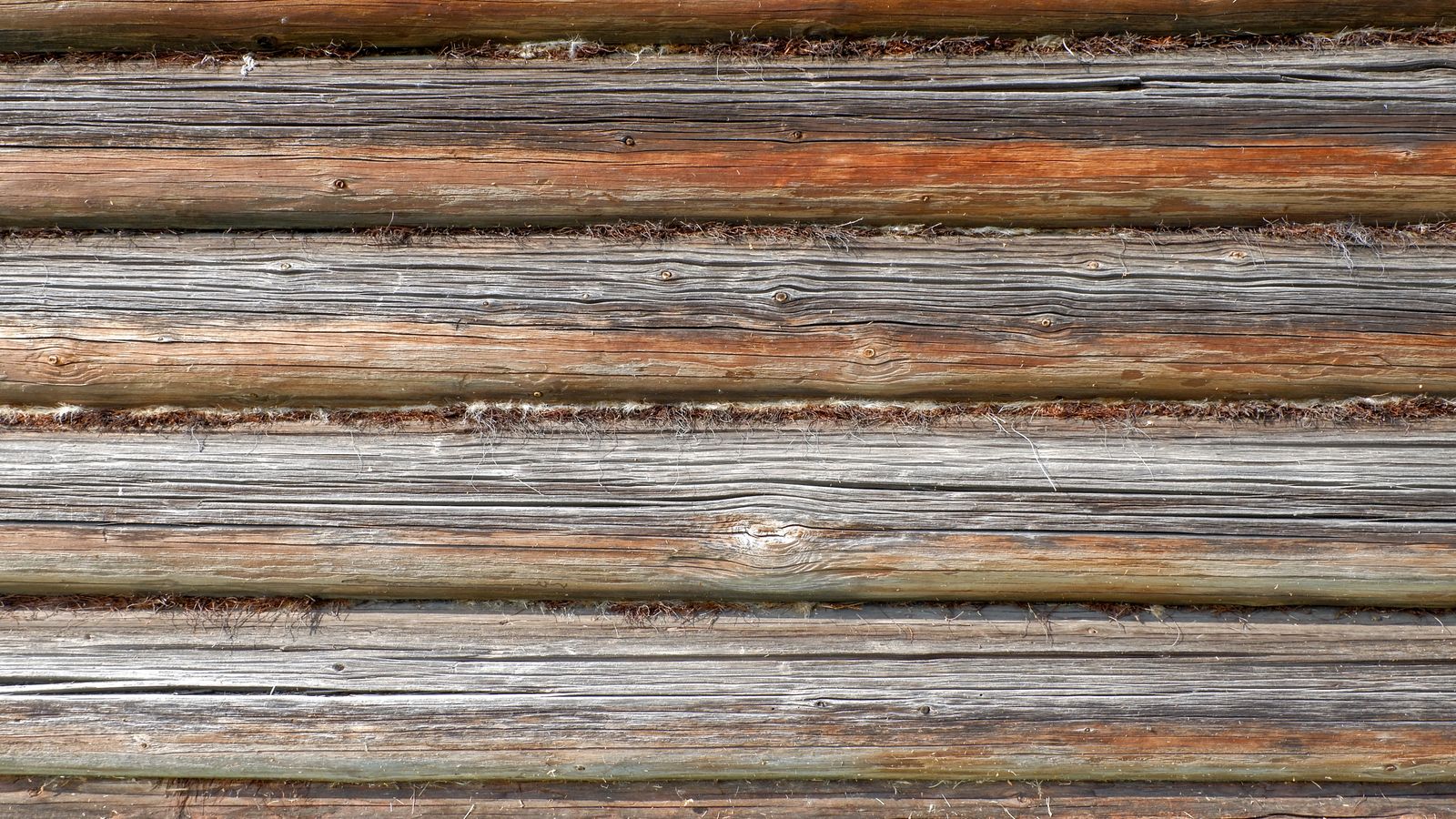
Chinking is the flexible seal between the logs. On old cabins it was mortar; on anything built or restored since the 1980s it's a synthetic, acrylic stuff that stretches as the logs move. It fails in predictable places: where it's pulled away from the log on one side, usually the top edge on sun-facing walls, and around windows and doors where the framing and the logs move differently.
Every October I walk the walls with a flashlight held flat against the log, which throws a shadow into any gap. Anywhere I can slide a putty knife behind the chinking, it gets cut out for six inches either side and redone. The product comes in tubes for small patches or five-gallon buckets for whole walls; a tube does about six feet of patch on a one-inch joint. Push it in with a trowel, smooth it with a wet brush, and it skins over in an hour and cures in a few days. I keep the color matched to the original, which on my cabins is a gray that's close to old mortar, because mismatched chinking looks worse than the gap did.
What I got wrong on cabin one: I patched over failed chinking with caulk from the hardware store. It looked fine for a year. Then it split, because regular caulk doesn't stretch the way logs need it to, and I had a bigger gap than before with a strip of dead caulk stuck in it. Use log chinking. It's $40 a tube instead of $8 and it's the only thing that works.
Budget for a normal fall: two to four tubes, $100 to $160, and a Saturday. On cabin three that first year: two buckets and a week. That's what neglect costs.
Staining: when, what, and the wall everybody forgets
Stain is the sunscreen. It's what keeps UV from turning the log surface gray and punky, and it's what sheds water. It wears out on a schedule that depends entirely on which way the wall faces. On my cabins in the Blue Ridge, the south and west walls need re-staining every three to four years. North and east, six to eight. The gable ends under a deep overhang, I've gone ten.
The test: splash a cup of water on the log. If it beads, the stain's fine. If it soaks in and darkens the wood, it's time. Do this on every wall separately, because the answer's different for each one.
Prep is the washing above, then a light sand or a wash with a wood brightener if the surface has grayed. Stain goes on with a brush, not a sprayer, for the same reason as the washing: control. Two thin coats on the sun walls. I use a penetrating oil-based stain in a medium brown that's close to the wood's own color, because dark stains show every scratch and clear ones don't block enough UV. Which brand matters less than which type; anything that soaks into the wood rather than forming a film on top. Film-forming finishes peel, and stripping peeled film off logs is the worst job I've done in this business.
Cost on a 1,200-square-foot cabin: about $400 in stain for the two sun walls, a weekend of two people. Doing all four walls at once, which I only do on a cabin I've just bought, $800 and four days.
The bottom logs, and what to do when it's too late
The lowest one or two courses take the worst of it: rain splash off the ground, snow sitting against them, damp from the grade. They rot first and they're the hardest to replace because everything above them sits on them. On cabin three, four bottom logs on the north wall were gone past saving. Replacement, meaning jacking the wall, cutting the bad logs out, and fitting new ones, was $11,200 for the four. I did the demo and my log guy, Ronnie, did the rest, because that's not a job to learn on.
The way to never have that bill: keep the ground a foot below the bottom log, keep it sloped away, keep gutters clear, and put gravel, not mulch, in the strip along the wall so splash doesn't carry soil up onto the wood. I did all of that on cabin three after the repair and the new logs have been dry through four winters.
If you find a soft spot that's shallow, an inch or less, you can dig the punky wood out with a chisel, treat the cavity with a borate solution to stop the rot, and fill it with a two-part wood epoxy, then stain over it. I've done that a dozen times and it holds. Deeper than a couple of inches, or more than a foot long, or on a corner where logs cross, call someone.
The inside: what most people never check
Interior logs mostly need nothing. Dust them, don't wax them, don't seal them with anything glossy. What does need checking is around the wood stove and chimney, where heat dries and cracks the logs over decades, and around any interior plumbing wall, where a slow leak can rot a log from the inside while the outside looks perfect. On the cabin I live in, I found a soft log behind the bathroom vanity three years after moving in, from a fitting that had been weeping since before I owned it. Screwdriver walk applies inside too, anywhere there's water.
The other interior job is the check where the logs meet the roof and the floor. Logs shrink and settle for years after construction, and the gaps at the top of the wall open up. That's where the drafts come from in a log cabin, and it's why the dark corners feel colder than the rest of the room. A bead of chinking along the top course inside, every few years, fixes most of it.
Bugs, and the borate answer
Carpenter bees drill quarter-inch holes in unstained or sun-worn wood in spring, usually under the eaves and along fascia. Powder-post beetles leave pinholes and fine sawdust. Both are worse on bare wood, which is another argument for staying on top of the stain. The fix for both is the same: a borate treatment, sprayed on bare wood before staining, which soaks in and makes the wood inedible. I treat every wall I re-stain. About $50 a gallon, one gallon does a wall. Fill carpenter bee holes with wood putty in fall after the bees are gone; plug them in spring and you trap the larvae in the wood, which is worse.
Buying a log cabin: what the maintenance history tells you
I've bought seven and walked away from maybe twenty. The screwdriver walk is what I do at a showing, before I've looked at the kitchen, and the seller's reaction tells me nearly as much as the wood does. A seller who's kept up a cabin knows the stain schedule and the chinking brand and has a bucket of it in the shed. A seller who says "it's never needed anything" has a cabin that's needed everything and hasn't gotten it.
Three things I check that most buyers don't. The bottom course on the north side, for the reasons above. The log ends at the corners, which stick out past the wall and catch rain from every direction; punky corners are the most expensive fix on the building. And the wall under any deck ledger, where the deck bolts to the cabin, because that joint traps water against the log and nobody ever looks behind a deck. Cabin five had a ledger that had been sitting wet for a decade and the log behind it was mush. I bought it anyway, because the price reflected what I'd found and the rest of the cabin was sound, but I'd have paid $15,000 more if I hadn't looked.
A cabin that's been maintained is worth paying for. A cabin that hasn't is worth buying only if the discount covers the catch-up, and you should price the catch-up at the numbers in this post, not the ones the listing agent offers.
The calendar, all in one place
April: screwdriver walk, wash the logs, check gutters and grade. May: stain any wall that failed the water test, borate first. October: screwdriver walk, chinking patch, plug bee holes, stack firewood away from the wall. Every three to four years: sun walls stained. Every six to eight: shade walls. Every year: nothing on a ladder in the rain.
Total for a cabin that's been kept up: $200 to $300 a year in materials and three or four days of work. Total for a cabin that hasn't: whatever it costs to replace what rotted, and it's always more than the years of maintenance would have been. Cabin three cost me about $14,000 in the first year to catch up. Every year since, under $300. That's the argument.
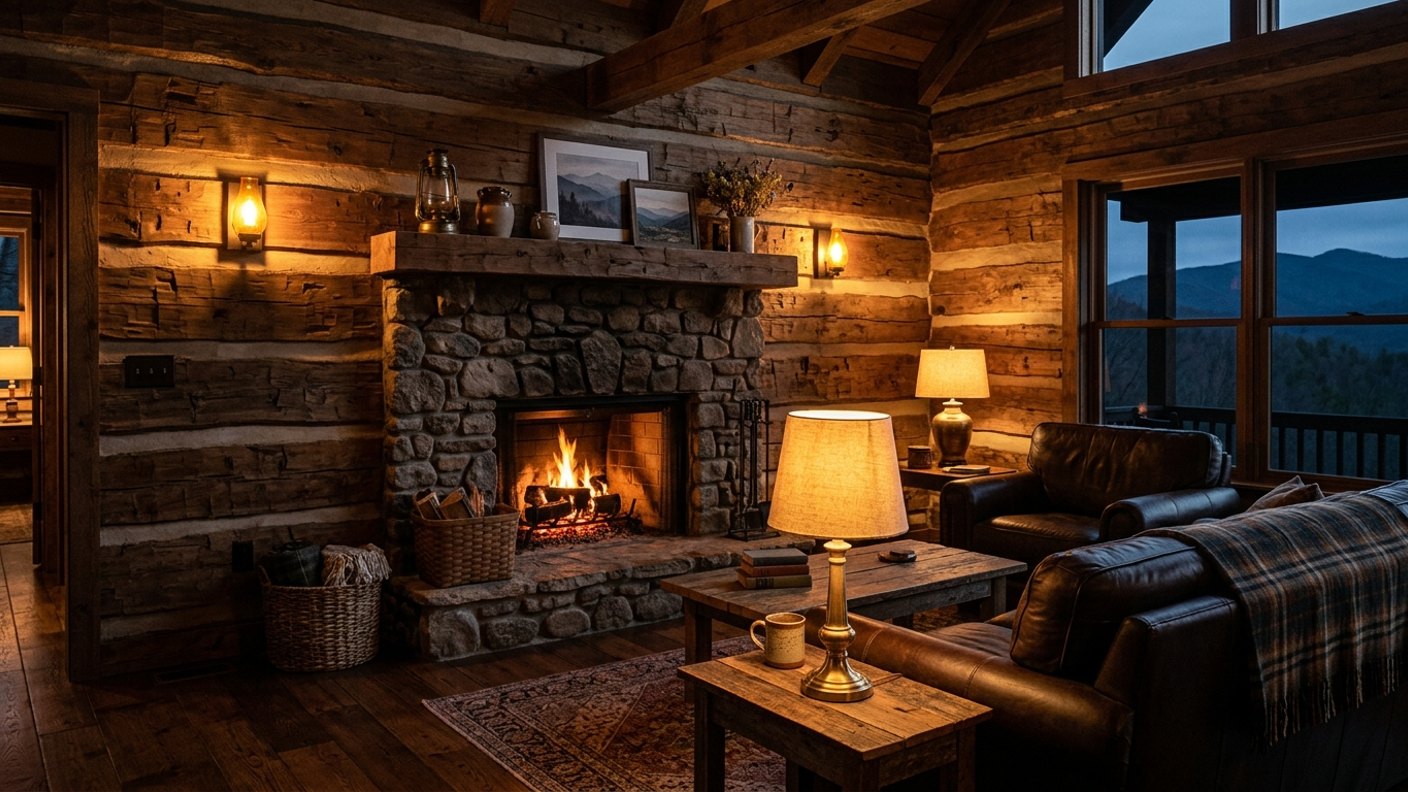
Once the outside is sealed, the inside is about light. Old logs drink it. A pair of wall sconces on the log wall, aimed up, warm bulb, does more for a cabin room than any ceiling fixture, and it's the first thing I put in after the chinking's done.